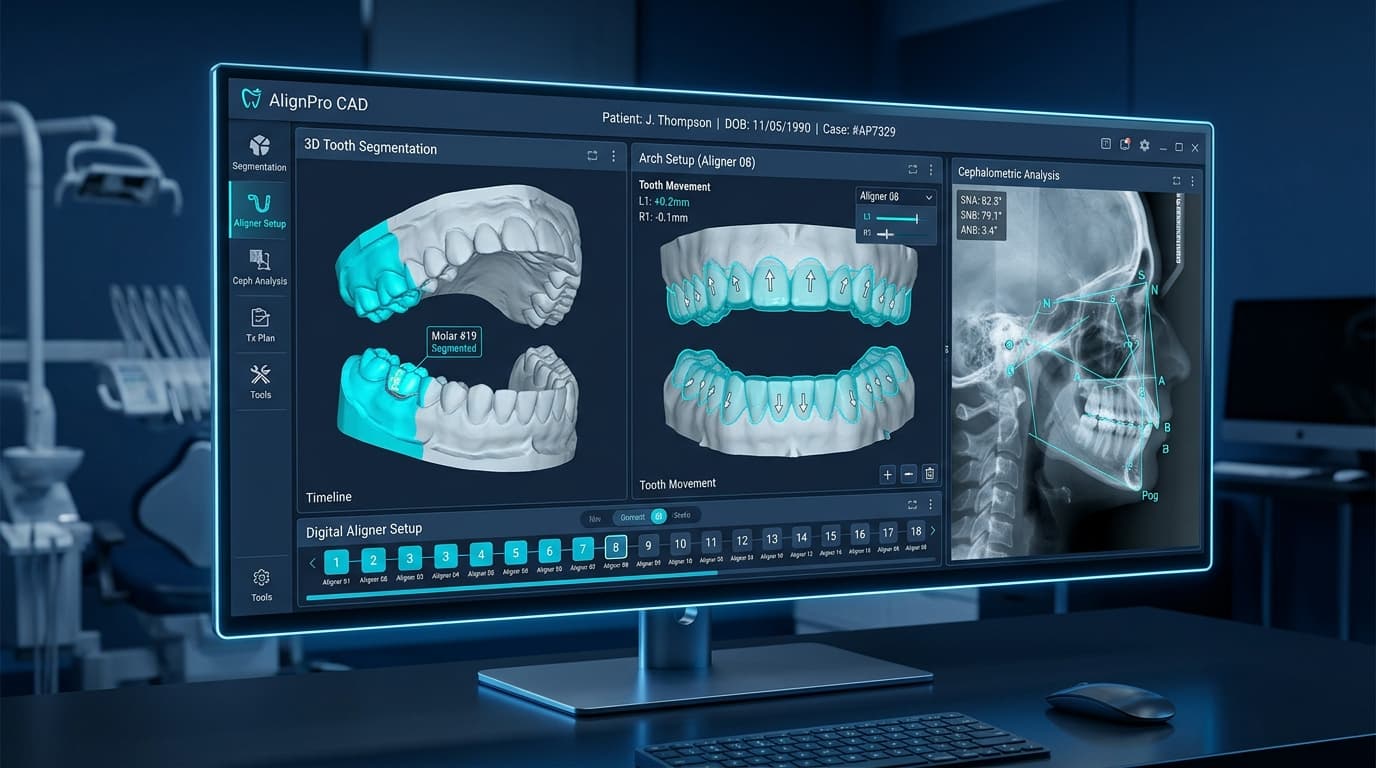
What Is OnyxCeph 3D Treatment Planning?
Discover the science behind OnyxCeph 3D treatment planning, virtual patient composite modeling, CBCT bone superposition, 3D tooth segmentation, and precision aligner force staging.
Key Takeaways for Orthodontists & Dental CAD Technicians:
- Medical-Grade Software Suite: OnyxCeph³™ by Image Instruments merges 2D cephalometric analysis with 3D CAD/CAM setup workflows, giving operators 6 spatial degrees of freedom.
- Virtual Patient Model: Integrates intraoral surface scans (STL/PLY/OBJ), CBCT root & bone superposition (DICOM), and 2D/3D cephalometric photogrammetry.
- Mathematical Precision: Linear translations controlled in steps of 0.15mm – 0.25mm per tray; rotational torque kept within 1.0° – 2.0° to maintain predictable aligner tracking.
- In-House Aligner Staging: Vector-targeted attachments and selective anchorage staging eliminate guesswork aligners and third-party markup.
In modern orthodontic care, achieving predictable aesthetic and functional outcomes is no longer driven by trial-and-error manual adjustments. Instead, it relies on precision digital CAD/CAM modeling. At the core of high-level digital orthodontic workflows is OnyxCeph³™ 3D Treatment Planning—a comprehensive diagnostic and virtual setup platform that turns raw clinical scans into biologically sound movement plans.
Understanding the science behind OnyxCeph³™ reveals how advanced data fusion, 3D tooth segmentation, and biomechanical staging protocols allow clinicians and digital labs to design clear aligners and orthodontic appliances with total mathematical accuracy.
1. The Foundation: What Is OnyxCeph 3D Treatment Planning?
OnyxCeph³™ 3D is a medical-grade software suite designed by Image Instruments to integrate 2D cephalometric analysis with 3D CAD/CAM setup workflows. Rather than acting as a simple 3D viewer, OnyxCeph³™ serves as an interactive clinical engine. It allows operators to manipulate individual teeth across all 6 spatial degrees of freedom while monitoring real-time anatomical limits.
2. The Science of the "Virtual Patient" Model
Digital setups in OnyxCeph³™ do not rely solely on visual surface crowns. To ensure safety during tooth movement, the platform builds a multi-layered 3D composite patient model:
1. Intraoral Surface Mesh Integration (STL / PLY / OBJ): Captures millimeter-accurate crown anatomy, interdental contacts, and gingival soft tissue contouring directly from intraoral optical scans.
2. CBCT Root & Bone Superposition (DICOM Data): Merges 3D Cone Beam Computed Tomography (CBCT) bone data with intraoral scans. This exposes true root lengths and orientations, allowing clinicians to plan movement without pushing root tips outside cortical bone walls.
3. 2D/3D Cephalometric Alignment & Photogrammetry: Overlays 2D clinical photos and 3D facial scans with skeletal landmarks. This ensures tooth movement aligns naturally with the patient's facial aesthetic midline and lip dynamics.
3. Mathematical Precision: Tooth Segmentation & Movement Vectors
Before movement can occur, algorithms separate crowns and root structures from the surrounding soft tissue. OnyxCeph³™ then evaluates movement using scientific movement parameters:
| Biomechanical Parameter | Technical Metric in OnyxCeph 3D | Clinical Biological Impact |
|---|---|---|
| Linear Translation | Controlled in steps of 0.15mm – 0.25mm per tray | Prevents periodontal ligament crush and hyalinization. |
| Rotational Torque | Limited to 1.0° – 2.0° max rotation per step | Ensures tracking along aligner tray flexibility bounds. |
| 3D Occlusal Distance Mapping | Color-coded distance collision matrix | Prevents premature occlusal contacts and traumatic bite force. |
| IPR Calculation | Precision millimeter logging per interdental space | Ensures exact arch length management without over-reduction. |
4. The Science of In-House Aligner Staging & Attachments
Clear aligners do not pull teeth; they exert controlled pushing forces. OnyxCeph³™ uses parametric attachment geometry to direct these force vectors:
- Vector-Targeted Attachments: Bevelled, rectangular, and custom 3D attachments are placed on tooth surfaces to act as artificial ledges, enabling complex movements like root torque, extrusion, and severe rotations.
- Selective Anchorage Staging: The software allows operators to anchor specific teeth in place while moving others, creating optimal counter-forces without unwanted side movements.
5. Why Science-Backed Digital Setups Matter for Your Website & Lab
Adopting OnyxCeph³™ 3D setups moves digital laboratories and dental practices away from "guesswork" aligners. By controlling the complete setup process in-house, clinicians eliminate third-party lab markup, accelerate treatment turnaround, and offer patients predictable, lifetime smile transformations.
Master Precision Digital Orthodontics
Looking to elevate your CAD crown design, aligner setups, or digital lab workflows? Partner with the digital dentistry experts at [velourcareortho.com](https://www.velourcareortho.com).
Ready to Start Your Digital Orthodontic Case?
Whether you are a dental practitioner seeking 3D OnyxCeph treatment setups or a patient exploring clear aligner options, our clinical orthodontic team is ready to assist.